

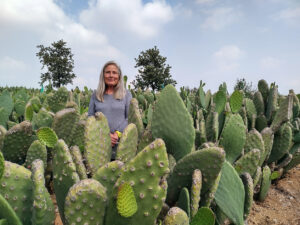
Frances Whitehead is an award-winning transdisciplinary environmental artist who integrates art with plants, soil, food, and agricultural sustainability. Having spent much of her career in cities of the Great Lakes Basin, she moved to New Mexico five years ago because she wanted to live in a dry climate and work on what she calls “arid reworlding” — which is all about responding to climate change by building a healthy future that uses less water. On a trip to Mexico, her life was changed by an encounter with the Nopal cactus, which has been a staple of Mexican culture for millennia. This led to her project, NOPALOGY, which addresses the potential role of Nopal as a future food in colder climates. In this podcast we explore the work with Nopal, as well as the role of the artist in agriculture and the food system, the latest research on Nopal, and the new field trials she’s initiated in Santa Fe.
TIMELINE and TRANSCRIPT
2’43 Frances’s background in art and agriculture
5’05 “What do artists know?”
5’52 moving to Chicago and seeing its environmental degradation
8’25 artists are lateral in their thinking, irreverent, disobedient, don’t follow the rules, and find problems and uncover connections
9’23 embedded artist in Chicago working to remediate abandoned gas station
10’42 how phytoremediation works
11’31 politics got in the way
13’21 moving from Chicago to Santa Fe, from a water-rich envitonment to the desert
14’53 “arid reworlding”
15’29 dwelling projects–turning their own home into sustainable spaces
16’31 Casa Agua
17’38 Xeriscaping
19’05 going to Mexico and discovering the nopal
20’11 going to Milp’alta, the center of Nopal growing
22’09 all the things they do with the Nopal plant in Mexico
22’59 prickly pear produces both fruit and vegetable
23’11 how Nopal seeds work
23’58 sustainable/unsustainable nopal growing methods
25’16.6268 Nopal as important future food
27’25 the importance of spineless cactus, especially if it’s used for lifestock fodder
28’26 looking for a cold-hardy nopal variety
29’51 John Cushman Nopal researcher in Reno, NV
31’22 tasting the nopal varieties
33’20 why the nopal pads are grown all year round in Mexico–it’s all about the pruning
34’34 you have to fertilize nopal if you want a vegetable orchard
35’28 creating a food culture
37’04 how do we capture all the knowledge about growing and eating nopal…creating the Nopal Growers Community Archive
38’52 eating delicious nopal stew
40’30 “operator’s manual” for the nopal
42’10 nopal snacks
43’13 the anti-diabetic property of nopal
43’46 making biofuels from nopal
44’17 drought fodder
47’00 intercropping nopal with mesquite trees
48’35 Reunity Resources test plot for nopal
50’56 building a nopal work force
52’17 in Mexico everyone has nopal in their garden that they use for food
55’34 using nopal pigments and dyes in art and textiles
56’19 what does the plant know? Is it us using the plant or the plant using us?
56’40 “The Nopal knows how to make community”
58’32 Frances making drawings with nopal pigment
59’34 building a community, calling for partners, Frances Whitehead site
TRANSCRIPT
Mary-Charlotte Domandi Welcome, Frances, to Down to Earth.
Frances Whitehead Hi, Mary-Charlotte. Thanks for having me.
MC It’s great to have you. It’s so interesting. I mean, you’ve spent your career integrating art and agriculture, and now you’re doing this project called NOPALOGY, which we are here to talk about. It’s all about the nopal cactus and its potential as a climate and water-friendly crop in the United States. But first, I would love to hear more about your background. I mean, you grew up in Virginia in a home where you were immersed in both art and agriculture. What, what was that like?
FW Well, my, my parents were modern artists. You know, they’d gone off to New York and came back Zen Buddhists and beatniks. But the extended family was consisting of all of the elements that you can see in my current practice. It was like I was genetically coded to do the work that I’m doing. So, on the one hand, uh, my father’s mother was the civic activist for the arts and ran the WPA for the State of Virginia. And then on my mother’s side, her father was a seed analyst and her brother was a sweet potato hybridizer. And, so we had both agriculture and beat poetry. You know, at, at the holidays where everybody comes over and says hi, you might go from beat poetry to sweet potatoes in the same cup of coffee. And so that really formed a very inclusive worldview growing up.
The other thing that was happening was more generational. I was what they call a Sputnik kid. Uh, if you remember, the Russians sent up a satellite and it sent the American government into overdrive to be sure that what we call, now we call STEM and STEAM learning, that the next generation of young people had plenty of math and science. But the way they taught it, it got linked up to the new math, and the new math was things like Booleans and set theory. And so I remember my fourth-grade teacher teaching us set theory on the piano with the black and the white keys. So even at the time, there was a lot of experimental education going on that integrated art and math into other disciplines, and it really stuck with me.
MC So you really have spent your career doing cross-disciplinary work. You’ve been able to talk to people with all different kinds of expertise. You’ve worked in government, community projects. You were, as we, you know, said in the intro, an, an embedded artist, and I’m wondering, like, yeah, that came naturally to you growing up in a household that was fundamentally transdisciplinary. You wrote a paper, a short paper that some people have called like a manifesto or whatever about what it is that art… It’s called What Do Artists Know? What do artists know that they can bring, that people like, that you can bring to work in sustainability and agriculture and environment?
FW Well, arriving at this place where I gave myself permission to move into a transdisciplinary practice did not happen right away. I had 20, 25 years of traditional art practice where I made paintings, sculptures, photography, showed them in galleries, and the work was almost always about the relationship of art and science, but I was not working with scientists. I was representing that relationship. And then I moved to Chicago to teach at the School of the Art Institute, which was quite a leap in terms of the kind of cultural milieu that I stepped into.
MC I mean, that’s a super famous, very prestigious art school.
FW Exactly, and the dialogue there is very advanced and very interesting and very challenging. But at the same time, I moved into post-industrial, the very last gasp of industrial Chicago. Chicago at that time was gray and gritty, nary a tree. This was before the famous Mayor Daley arrived and planted something like, I don’t know, some outrageous number of trees.
MC A gazillion, I think he said.
FW Yeah, a gazillion trees. I mean, he bought up every tree in the Midwest that was large enough to plant and depleted the nurseries. It’s sort of famous. But before that, when I got to Chicago, I was really influenced by and struck by the environmental degradation from 100 years of being a Rust Belt city, and of course, those Rust Belt cities, now they call them “Legacy” Cities, and that’s Cleveland, Detroit, Gary, Chicago, and it’s all about the Great Lakes, and much of it is about steelmaking and what is required there. The detritus, the leftover environmental degradation in the city, galvanized me and worked on me and eventually politicized me to change the nature of my practice.
Now we’re in the late ’80s, early ’90s, and there comes this word sustainability, which now we’ve all heard 1,000 times. But early on, no one knew what it was and what was the role of culture or artists. Now we could say sustainability is a cultural problem because it has to do with our values and our way of life, but nobody knew that then. And so I began to say, “What do artists know that can contribute to the future?” This was a question to myself, and asking this question and pursuing an answer, I went out into the design field that I didn’t know anything about.
I got an opportunity to work in Cleveland with the Cuyahoga County planning people. And so asking this question, “What do artists know?”, I began to ask other people what they thought that we knew, and we started writing it down. And after two years, we had this quirky list that no one knows what it is. Is it a manifesto? Is it a “knowledge claim”? or is it just a quirky list?
It outlines some of the perceptions that people have of how artists and cultural workers can contribute to the larger project of reconnecting the dots. Because it turns out this is the best thing that artists can bring, is we’re very lateral in our thinking. We’re very irreverent, or some people say disobedient, which cracks me up. I love being disobedient. That we don’t follow the rules, and that turns out to be a good thing because we do some problem-finding, not just problem-solving. We uncover connections.
Out of that, emerged, in the city of Chicago … I was able to present that document to the new civic innovation people. And they said, “This is how you’re going to get a seat at the table.” Artists are always asking, “How can I get a seat at the table? How can I be involved in the kind of decision-making that affects us all?” And so this platform emerged out of that document, out of asking that question.
MC What did you actually end up doing? How did that translate into environmental action?
FW Well, very good question. The first place I was embedded was in the Department of Land Use Planning, which was doing food planning, the 2040 Food Plan for the City of Chicago. It turns out we didn’t really have any data, so we were doing what we jokingly called “planning to plan”. It wasn’t actually very fruitful because they already knew the outcome.
Then I went to the Department of Environment, where the brilliant Suzanne Malec-McKenna, the Department of Environment Commissioner, had a better idea how to use me. She gave me her best brownfield engineer, and she sat the two of us down and she said, “We have 400-plus abandoned gas stations in the city of Chicago. What can we do with them? And what does a sustainable brownfields cleanup look like? Go come up with something.”
And by giving us a problem space but not an outcome, we were able to work very productively, and out of that came the Slow Cleanup project, working with Purdue soil scientists on phytoremediation of petroleum products, which is a very prevalent contaminant.
MC So phytoremediation means taking plants that basically absorb the toxins, or what does that look like?
FW Well, people always associate it with uptake, which is what you’ve just described, but there are actually a lot of different processes. And because petroleum is a carbon product, the way it works is certain plants exude sugars called phenols, and the phenols rev up the native microbial community that’s in the soil, and the microbes eat the petroleum. So there is no uptake. But for some reasons, they’re not sure what the silver bullet is, some plants have a magic exudate that makes it happen, and some plants, like legumes, they don’t work. And so we tested 40 native ornamental remediators and found a whole bunch of them.
MC So did you clean up all these gas stations?
FW Well, we did an analysis and found about 10 candidate gas stations, and we had different landscape typologies. It was going to be a very ambitious project. We installed the Cottage Grove Laboratory Garden, which was the field trials for the lab trials by the soil scientists, and while we were installing that, there was an election, and we had a new mayor. And Mayor Rahm Emanuel came in and shut down the Department of Environment and all of the projects that it was doing, including our phytoremediation program.
And I’ll just say that we have, “we”…Anymore I don’t say “I”, the artist individualistic “I”, I say “we” because now there are always people involved. People say to me, “Who are the “we”?” Well, it’s different with every, every reference, but the pronoun is “we”…. Anyway, “we”, at the studio, we’ve also had other projects being done with governments where the change in elected officials have killed the projects. When you do long-term projects that span different administrations, they sometimes get dissolved before they come to fruition, and it’s really too bad.
Same thing happened in Lima, Peru with their urban agriculture planning. The first woman socialist mayor, Susana, as she was known- Was dedicated to improving the lives of the urban poor, including urban agriculture installations. And we went there and planned for about three years with them, and then she was recalled by more conservative forces, and none of them were ever built.
MC Oh, man. We could talk forever about the things you did before you moved to the Southwest, but let’s talk about what you’re doing now.
Five years ago or so, you moved from Chicago to Santa Fe, New Mexico, and, you know, we’ve– you and I were talking about how there are so many environmental problems in the Midwest, in the sort of post-industrial landscape that you describe, but one thing that they had was water, and you moved to a place very consciously where there was much less water.
FW Well, after working for twenty-five years in Chicago around these very complex systemic legacy environmental conditions, you come to understand that there is nothing outside “water’ in the Great Lakes. The Great Lakes are twenty-three percent of the world’s fresh surface water. It’s a global resource. It’s an enormous amount of water, and it makes the water ever present and completely invisible to the people that live there, except for a small handful of dedicated environmentalists who take stewardship of that issue. I couldn’t really get any traction thinking about water in that area. So when my husband and I finally graduated from college and stopped teaching, we decided to beam into the arid future.
MC Meaning graduating from teaching?
FW Yes. People say retired, but I didn’t retire from anything. Artists don’t retire. We just quit our day jobs. When I finally quit my day job, we made a plan to move to a new area where we could work with what I now call arid re-worlding, getting the world ready for the arid future that is coming. And because Santa Fe is also a cultural town, and it’s a very small and livable city, we decided to move here.
MC So you immediately bought and renovated a house, and you call it Casa Agua, and you put in a water catchment system and gardens. Tell us about that, that whole project, and what it was like to adjust to this new climate.
FW When we first got started, in addition to the Embedded Artist Project, my husband and I began to collaborate on what we came to call Dwelling Projects. We took the place that we were living and transformed it to try to demonstrate some aspect of sustainable living. The first one in Chicago was called The Greenhouse Chicago, and that was all available energy generation systems. The second one in Gary, Indiana, where I was working with fruit, was an edible landscape.
And the third one, Casa Agua, is focused on being a demonstration for water conservation measures. We knew that we were moving to Santa Fe quite a few years before we actually did it. We began to plan the Casa Agua, and it’s what is known locally as a Stamm house, the kind of houses that were built post-war ranch, faux-dobe—they’re stick-built. They’re not actually adobe—stucco houses. They are the primary everyday house here in Santa Fe. We took one of these, built in nineteen forty-eight.
It hadn’t been renovated. It still had all of its original antiquated systems. We updated it and built this demonstration project where we did what we like to call The Complete Set, …everything that you can, (within building code), everything allowable that you can do. That includes rainwater catchment, gray water, xeriscaping, micro grading and terracing for passive water capture with swales, et cetera, et cetera. The landscape already had a lot of existing plants, mainly junipers, that are common here, of course.
And the back part of the house that were garages had a big parking lot that we pulled up. We cut it up. Actually, my husband cut it up, and we built all the terraces. Our motto is “reuse everything”. And this became what we call the Future Garden, and that is completely xeric. And of course, in the xeriscape-
MC Xeric meaning what grows here locally?
FW Xeric means low water plants. So cacti, yucca, and agave figure heavily in the xeriscape. And we are here in Santa Fe, interestingly, in what’s called an ecotone.
We are a border ecology between where the elevation goes up and you get into the higher elevations that are wetter and colder. And as you go south towards Albuquerque, you’re getting into the dry shrub land that turns into, more of a deserty, drier condition. That border ecology is at seven thousand feet, and Casa Agua is at exactly seven thousand feet. Our xeriscape is demonstrating that principle. I was working already, was very excited to work with cacti, especially Opuntias, prickly pears, and that set the stage for what came next.
MC So Opuntia prickly pear, nopal. That’s all different words for the same thing?
FW Now we’ve, we come to the NOPALOGY Project. So I’ve moved to Santa Fe. It’s during COVID. It was a wild time. We are tearing up driveways and putting in yuccas and cactus and gray water systems, and I get invited by an old friend right when COVID lifted in about 2022, I get invited to come down to the Monterrey Tec University in Mexico as a visiting artist, what they call Creative Leader, to talk about mainly embedded artists and the kind of transdisciplinary projects that we’ve been discussing.
I said to him, “Oh, I’ve always wanted to see the big nopal down at Mexico City.” Now, nopal is the culinary prickly pear. All prickly pears, which are Opuntias, all of them are edible, but they’re not all culinary grade. There are some you can eat, but you wouldn’t want to. They’re too prickly or maybe they’re too fibrous, and it’d be like eating a piece of cardboard, (which you can also do.)
So, he invites me down. The nopal, which comes from the Nahuatl word nopalli, is famous throughout Mexico. It’s on the Mexican flags. It influences and is a part of everyday life in Mexico because it is a very versatile plant, and you can do almost anything with it. They fly me down to Mexico City to where the most famous area for the growing nopal is, which is Milpa Alta or Mil-palta, as they say, and this is the center of nopal growing for Mexico in terms of production, something like 850,000 tonnes a year, which is shipped all over Mexico and elsewhere, I believe. For some reason, the Japanese have gotten onto it.
But anyway, so we go to see the nopal fields outside Mexico City in Milpa Alta, and I have to tell you, I have a religious experience.
MC What do you mean?
FW Well, I expected the nopal to be like most prickly pears that I had seen in my life, which is to say about two feet tall. Well, they are, the ones that are being raised for a crop are kept at about four to five feet, and walking, around, they refer to them as orchards, even when they’re not growing fruit. Walking around through these magnificent, stately, incredible plants, I felt like Alice in Wonderland. I had a scale shift perception where all of a sudden, I was small, and they were large and heroic.
You know, the nopal has been bred by the Mexican people going back somewhere between 10,000 and 14,000 years. This is how long they have been working on this magnificent plant, and you could feel it. They were ancestors, and you could feel the intimate relationship between the Mexican people and their plant.
MC One of the things that you learned when you were there was not only that the nopal has been part of Mexican culture for these thousands, tens of thousands of years, but also that it’s used in so many different ways. What are some of the things that the nopal is used for in Mexico?
FW Well, as it turns out, they use every part of the plant. It’s very adaptable. You can eat it. You can feed it to animals. you can eat the fruits. The fruits contain, and I got very interested in this and have been pursuing it, a very particular kind of pigment called betalain pigment that is antioxidant and very nutritious to eat. In fact, the nopal is an anti-diabetic, very nutritious vegetable. The mucilage can be added to lime and used as a sealant for adobe structures. You can make paper out of the pads, and the list goes on and on.
MC One of the things that’s interesting is the plant produces fruit, the prickly pear fruit, and also the pads, the sort of flat pads, are vegetables. So it’s like a vegetable and a fruit?
FW Yes, both are eaten, and there’s so many interesting things that I have learned about this. So backing up a little bit, when I go to this nopalera, this place where they’re growing the nopal, and I hear the owner say, “The seed is not viable. It’s always grown vegetatively where you cut a pad, and you stick it in the ground, and it roots.”
Well, I know a lot about plants, and I just didn’t believe it. I just thought, evolutionarily, no plant is going to produce thousands and thousands of seeds every year that are not viable. So, what’s up with that? I didn’t really go to see the nopal simply because of its mythological and cultural standing in Mexico. I went because I had heard that the traditional methods of growing are sustainable, but that the small growers are under pressure to produce more and to move to unsustainable industrial agriculture methods, and that is actually what I wanted to see.
I came away with these questions about seeds and also questions about methodology, about how they were being grown. And the one question, it turns out the seeds absolutely germinate, but they have germination inhibitors, which make them very difficult to germinate. And in addition to that, the nopal does not come true to seed. So if you plant the seed, the plant you get will not necessarily resemble the plant you took the seed from. Many plants are like this, like apples operate this way, sort of a, it’s a thing, about not coming true to seed.
So, the seed is not true, and it’s difficult to germinate, and it’s always done vegetatively. And so the 10,000 years of perfection that have happened have been done primarily through selection over very long time frames. So the one question of seeds and the larger question of sustainable agricultural methods, or now we might call that regenerative agriculture methods, that quickly turned into four questions.
As I became more and more interested in nopal, I discovered pretty quickly that many groups, including the UN Food and Agriculture Organization and many other people who work with food security, were saying that the nopal was an important future food because it has very little inputs needed. It uses little water and not a whole lot of fertilizer, and it is super nutritious, so minimal inputs, maximum outputs. And of course, the fact that it grows with minimal water is very important.
As I got into that, this question of what would it take for the nopal to become an important element in global food security, I found a book from 2010 by Park S. Nobel, who is pretty much the, the sort of Einstein of the cactus world. He’s the one who discovered how the biochemistry of succulents and the biochemistry of what is called CAM photosynthesis, which is basically the cactus do all their business at night, and that’s how they don’t lose their water. They’re very smart. It’s a very special thing that succulent agaves and cactus and other things use. The CAM plants are really important for arid conditions.
Park Nobel says that there are two constraints that keep the nopal cactus from becoming a major contributor to future food security. One is climate, and one is culture. Culture meaning that in the United States and other places in the temperate zone globally, there is no food culture. These are foreign. They are not familiar foods. People don’t know how to prepare them or eat them, et cetera. But the big thing is that we do not have cold hardy spineless varieties.
MC So cold hardy meaning that they can be grown in places like where we are here in northern New Mexico, as opposed to really all of Mexico, and the spineless is if there are so many different varieties and there are ones that have fewer or no spines on them, which means they’re a lot easier to handle and to cook.
FW Well, let’s take spinelessness first. Spineless is important. If you’re a human and are going to eat these, removing the spines is pretty easy if you know how to do it, and people who are not familiar can learn how to do it. But if you’re going to feed them to animals, they have to be spineless or the animals get in trouble. So for use with fodder, spinelessness is super important. Although sometimes people burn them off and do other kind of laborious interventions, especially in times of drought when there’s nothing else to feed their animals, they will take spiny ones. This is fairly prevalent, not just in Mexico, but Argentina and other places where they use them for fodder.
But the question of cold hardiness has been a moving target. So when I really did a deep dive into this question, I began thinking we were going to have to breed a cold hardy nopal cactus, and I was wondering who else had thought this question. I discovered a man named Peter Felker, who worked at Texas A&M in the ’90s, and he’s the primary breeder looking for cold hardy varieties, but his idea of cold hardy was South Texas, so that’s zone eight.
Mexico, where they grow, is maybe zone 10 or something like that. Well, my ambition, I’m thinking that for this to really be useful for the temperate zone, we need to have about zone six. Of course, I would love to have zone five, but I’m not sure it’s happening.
MC The zones get lower numbers as you go further north?
FW Yes, these are the USDA climate zones. If you’re any kind of a gardener, you probably know what kind of zone you’re in. Santa Fe used to be zone five. Chicago used to be zone five. Now they’re both zone six, although they’ve been acting like zone seven the last year or two because it’s been so warm.
I began to see that if I want this to go through the temperate zone globally, we need to get to zone six, and that is where Santa Fe is. So Peter Felker was aiming for zone eight. Now, he retired, and all of his work went to a man named John Cushman at the University of Nevada, Reno, who I am in contact with and who is long-suffering and helping me a great deal with the questions that I have. He has an encyclopedic nopal or Opuntia project. He’s primarily looking at biofuels and fodder, and is very happy that other people are taking up the cultural question.
All of Peter Felker’s work is now with Cushman, and many other collections. He has 400 accessions, different varieties. I’ve been to visit his greenhouses, and it’s really something, and he knows everything about all of these different varieties. So it seems pretty clear now that there are adequate varieties. We don’t have to breed one.
MC That’s actually really good news. These varieties already exist. They’ve already evolved or were bred. So what are the consequences of that?
FW Well, I was really thinking we had to breed one, and I was all about Peter Felker and his work. And then I’m talking to the fabulous Marisa Thompson down at the Los Lunas Extension Office south of Albuquerque, and she says, “Well, are we sure that the ones that are growing around here already are not tasty? Nobody’s ever tasted them that I know of. What if we start by tasting what we have?” So I began to beg, borrow, and steal pads, and put them in my own little cactus lab at the Casa Agua Future Garden, where we have a small little planting area. I have identified five from the surrounding area.
One I got from the famous plant breeder, David Salman. One I got down at the little town of Cerrillos, where they have big ones growing in the street. There are a few others. I have five spineless or near spineless endemic species or garden cultivars that grow all over Santa Fe, and we’ve been growing those, and finally they got big enough where this spring we could taste them. And they were all delicious. They were different from each other. The Mexicans frequently talk about certain ones being more acidic or lemony and others being less. Less lemony, less acidic seems to be desirable in Mexican cuisine. Of the three, one was more lemony and two were similar to each other and less lemony. But they were, as far as I could see, all totally acceptable.
MC Now, were you eating the pads or the fruit or both?
FW Yes. when we talk about nopal, if it is the vegetable, they refer to it as nopalitos, and that’s the vegetable pad. They only eat the brand-new pads. They’re harvested ideally when they’re the size of your hand. And if you have a plant that has some spines or the little hairy ones, the glochids, which are really the irritating things, they probably aren’t formed very much on this new pad. Also, on the same plant or different plants, you might grow the fruit, but you either grow fruit or pads, not both.
MC Because if you’re growing the pads, you kind of trim off or prune off the fruit to put all the energy into the pads.
FW Well, yes. I have been looking for the last couple of years to the answer of why are all the nopal plants in Mexico productive all season, and around here they do a flush in the spring, and then they stop, and they might make fruit, they might not, but they don’t make pads anymore.
And most of the people that I spoke with thought that it was either temperature or light. But it turns out it’s all about the pruning. The traditional method of growing, I’ve just discovered, I’m so excited, in the last, really the last month, discovered that there’s a very specific way to prune it, to prune these plants. They call it bunny ears. You put the “mother “pad in. Then you allow two, like bunny ears, maybe three secondary pads, “daughter” pads, and then what comes out of there are the nopalitos that you harvest to eat.
And if you keep that pruned, because of apical dominance or some such, the plant continues to push out new pads. But because it’s pushing out new pads to replace available photosynthesis, (it’s a natural plant phenomena evidently), it depletes the plant readily and you have to fertilize it. Well, here in New Mexico, nobody ever heard of fertilizing a cactus, but if you want to turn them into a vegetable orchard, you have to fertilize them. And I have discovered that the traditional method is with horse manure mixed with sawdust.
MC Very interesting. So when we’re thinking about, you know, this arid re-worlding, this arid food future that doesn’t drain all of our rivers and take up all of our water, that allows us to really look forward, it’s not only this question, like the … You’ve, you’ve got the four questions that the first one being can we grow nopal in more temperate zones, but the second question is, who’s going to eat them? What is the culture? Like, how do you create a food culture where there virtually is none? Like, I don’t, not sure if there’s very many places where you can, in a restaurant or in a store, where you can even find prickly pear cactus or nopalitos.
FW Well, that’s a really important question. As you say, the first question is, do we have some candidates that we can begin to test? And then the second question is, how do we get people to try it? And I’ve never started a food – new food culture- … but I think it’s a really important and interesting question. And with social media and the internet, I think it is not as difficult maybe as it used to be. One of the things we haven’t talked about, I’ve alluded to it, but I think it’s really important to mention here, is that, uh, we already talked a little bit about that there’s industrial production and there are the traditional methods of growing, which I’m more interested in because it’s sustainable.
And all over Mexico, in the many different kinds of ecological regions where this nopal is grown: very hot and dry up north; as you come down around Mexico City, the elevation is high, but it’s not quite as dry; and then all the way down to Oaxaca, they’re eating other varieties and putting mole on it; it’s a completely different (food) culture. So we knew that the food culture that you would be possibly producing would reflect the bio-region and the culture where you were establishing that.
How do we capture all of the knowledge, both of growing and also of cuisine, of preparation in Mexico? And, it’s very important to me to acknowledge authorship and to acknowledge that the Mexican people, over 10,000 years, have produced this incredibly important global knowledge resource in the form of this plant and its methods. So we are also creating what we’re calling the Nopal Grower’s Community Archive, and I’m traveling around Mexico ¬–we’ve taken several trips, and this fall we’re going to take several more¬¬¬¬ –¬¬and talk to small holdings growers in different regions of Mexico to get their growing information, and making videos of these people, and they are attributed. This is their information that they’re sharing.
We’re also going to ask, in each village or in each farm, each nopalera, “Who’s the best cook? What’s the best way to make this, and who does the best job?” We’re going to do a video interview of different basic preparation methods. This is not just a cookbook or heading towards a cookbook. This is really about preparation methods: grilling, stewing, stuffing, salads, pickling, the basic preparation methods, and of course, starting with removing the spines.
MC Right. You know, can’t forget the removing the spines. That’s really important. Now, are you doing these things? Are you eating it? Are you cooking it and stuffing it and all, pickling, all of these kind of things?
FW Well, so far, my culinary adventure has only been with grilling, but I’m interested to learn more. I did eat the most delicious nopal stew with a woman named Mona right outside Monterey when I was visiting Monterey Tech, and we’re going to go visit Mona again and see if she’ll share her recipe. The stew, the nopal was cut in quarter-inch pieces and cooked in a tomato, onion kind of stew situation and served with perfectly cooked pinto beans, tortillas, and the hottest salsa I’ve ever eaten. We’re going to go visit Mona and get Mona’s recipe.
But anyway, we’re asking all of these farmers how to grow them, and when I did the first videos, I didn’t know, I hadn’t gotten around to thinking about how do you maintain continuous production for the whole season. I just thought it had to do with Mexico being further south, but actually it turns out it’s much more complex than that. I’ve been reading about it in scientific journals, but now I look forward to finding out more about that.
Now we know that here in New Mexico, we have to find some varieties. We have that. We have five locals that I’ve found, and we’re going to get five or six from John Cushman with any luck. Then we have to learn how to grow them and how to prune them for continuous production, and if we can get them to produce, then we can start bringing the public along for the ride, and having some tastings and this kind of thing.
MC And growing the food culture.
FW And growing the food culture. And one last bit that we have, you’ve probably heard of a farm to table cookbook. We want to do more like an “Operator’s Manual” for the nopal, because that would include a farm to table element: here’s how you grow it; here’s how you get the spines off; here’s how you prepare it. But also, circling back to what we talked about earlier: here’s how you make artist pigments; here’s how you make the lime mixture for your adobe house to whitewash the inside of your walls; here’s how to make paper out of it, here’s how to feed it to your goats.
I haven’t looked too much into fodder, because I don’t know that much about raising animals. But I think that, you know, goats do one thing with it, and cows do another. And there are people that know that. There’s a ton of information out there about using it as fodder. This is one of the big areas of study, so I know that some of that could be in the book. And people would expect other things to be in the book.
For example, many people know that the prickly pear is the host for the cochineal insect that is the source for the brilliant carmine red dye, which is why the Spanish took this plant and the insect back to Spain, where the plant became an invasive nuisance species and spread all over the Mediterranean. They also eat the fruit there, but not so much the pads.
MC As you’re talking, I can’t help but think about American food culture as it is, and by and large, I think Americans are a little bit risk-averse, and they like prepared foods and things like that. Do you imagine any way that, you know, nopal could be made into a snack food or something like that?
FW Well, in Mexico, you can get nopal chips and nopal cookies made with amaranth, and powdered nopal to put in your smoothie in the morning, and every conceivable kind of product that you could use it for. I think that the really important thing is the fresh vegetable, because eating those, you know, we don’t always just want to eat powdered vegetable, we want some fresh. You know, if we run out of water, the green beans are out, and the nopal is in.
MC Right. Now, there are people, you mentioned John Cushman in Reno, Nevada, there are people in the Southwest, and in different places doing research on nopal, and, you know, there’s real interest. There’s grants available. What kinds of things are they looking at? How much crossover is there with what you’re looking at?
FW Well, I’ve looked at all the people that have grants, or that I can find. There is a huge amount of interest in Mexico and here in the anti-diabetic properties of eating nopal, and in this case, it might be the fruit, but we’re really talking about the pads, the vegetable. It has certain known medicinal functions that help with diabetes and cholesterol, so it’s very much good for what ails us, because of course, that’s a widespread problem in Mexico and everywhere in the world because of industrial food. So all of these grants, that’s one component of what they’re looking at, and then there is the biofuel aspect.
MC They want to make biofuels out of nopal cactus?
FW I believe it might be the pad, but there is also interest in the oil that’s in the seeds. This idea of using, because the sheer volume of seed produced is phenomenal, and that there might be oil in the seeds, I believe, is a thing.
MC Interesting.
FW But there’s also interest in economic development and it as a stopgap measure in drought times. Even in Mexico, the government is introducing the idea of a drought fodder into areas that have never had a water problem, so that the subsistence farmers can keep their animals alive, because they’re also experiencing aridification in parts of Mexico that have never been dry. So there’s a lot of interest in fodder.
But the grants that I have found, many of these, older ones especially, assume that we’re going to use the plant, the principal plant grown in Mexico, which is Opuntia ficus-indica. And ficus-indica is the one that I saw in the Nopalera that I visited, and that is the one that Peter Felker was trying to cross-breed with local New Mexico species and Texas species to make it more cold-hardy. But ficus-indica will not grow in zone six. Now, if we have a very mild winter, they would make it, but in the last five years, we’ve had two winters where it got below zero, and they would not make it in that kind of weather.
So a lot of these grants are assuming we’re going to have ficus-indica here, and because of climate variability, we’re not going to have it here. We can’t grow it here anytime soon, because all you need is one cold night and your crop is gone.
MC Now, you said earlier that there’s pressure on small farmers in Mexico to industrialize and grow nopal as a mono-crop in the sort of industrial model. How are the farmers growing it now? And, I mean, is there a regenerative aspect to nopal growing that you saw, and is that something that we could replicate here?
FW I didn’t actually see it. In Milpa Alta, they are mono-cropping, but it is small plots, you know, an acre, something like that, half acre, two acres maybe at the most, and it is all manual. Many of them are organic. They’re using horse manure, and they are hand-cultivated and hand-harvested. So this is a really good question. What would a regenerative model look like here in New Mexico? So they are sometimes feeding the nopal to their animals. The animal manure is now going back on the nopal, so it’s a closed loop in that regard. Is that enough? Is that all we get?
Well, in the wild, many nopal grow near mesquite trees. Now, mesquite is a legume, and there have been studies about intercropping with mesquite trees. One of the traditional methods in polyculture, in agroforestry, is to grow with different kinds of bean crops. So that can be small beans, or that can be the mesquite. And we could ask ourselves then, because of course they produce nitrogen, and the nopal is a heavy nitrogen user: it’s green; it’s growing vegetatively; it needs a lot of nitrogen.
So coming to New Mexico, somewhere I read, and I think it’s a great idea, we have the famous New Mexico locust trees, right? Robinia neomexicana, which I think is just a no-brainer to try out some intercropping with the locust.
MC And that’s a legume.
FW That’s a legume. Yes, it is. Although they do say that they sucker. The word is that the New Mexico locust suckers, which means it, it puts out rhizomatically under the ground, and new trees come up, and that would be very difficult to maintain a nopal row if it was constantly getting full of locust suckers.
MC Right. So these are some of the issues that we’re going to have to really look at and experiment with, if nopal becomes something that is part of our food future, is part of our economic development. One of the things that you’re doing is you’re working with this wonderful farm called Reunity Resources here in Santa Fe. We’ve a link to, we did an interview with them a while back, which I’ll link to in the show notes. You approached them, and you’re going to have, what –a nopal sort of test growing plot?
FW Yes, I was really excited to go and speak with Juliana and the people at Reunity, our local closed loop, public outreach, community farm. It’s a large-scale operation. It started as a soil yard. They’re committed to regenerative processes. I approached them about hosting the test plots. Now that we have 5 or 10 candidate species, we are actually ready to do some kind of testing, where we can test for: vigor, pest resistance, biomass. We can learn to prune, and we can taste. And I was delighted that they said “yes”, and because they have this fabulous program for children, Farm Camp, where they learn all about growing and eating vegetables, and because they are operating at the scale that our inquiry is at next.
And by that, I mean to go from my little five-plant cact lab in, in my backyard up to, you know, Juliana said that they could easily do 30 feet of row, so we could have some iterations. We could have all 10 different varieties, and we can involve children, who of course are the next generation. They will be the big nopal eaters, because they are the future eaters, they can learn about the nopal.
The fact that they can operate both with the knowledge production of growing- the scientific aspect, agronomics of growing, and figuring out the polyculture or the companion plants or whatever can be done in that regard, and introducing the public through food and culinary and educational events, they can operate at both of our constraints that were identified by Park Nobel in 2010, climate and culture.
MC There’s another aspect to it, too, which is building a workforce, an agricultural workforce that knows how to deal with nopal, fertilize it, prune it, harvest, all of those things.
FW Yeah, as I mentioned, with the next trip down to Mexico to interview growers, I now am armed with… I’m going to ask a much better question than I asked the first time, and going to try to find out the details of these pruning methods. I think we will probably need to invite some growers, some experienced growers, once we get some plants going, and good size, up to demonstrate for us, and we can hold workshops.
In Mexico, they not only have the nopaleras, which are the small fields of nopal, and they have the large industrial mono-fields of nopal, but people also continue to eat wild nopal of every species. In some areas like El Bajío in the middle of the country –I always get mixed up if it’s Baíjo or Bajío, but anyway –around Guanajuato and San Luis Potosí, they’re famous for eating something like 70 varieties of nopal. So we have a lot of nopal here, and as people get more familiar with it, people are going to go out and do some tastings on their own, which is really interesting.
So in Mexico, they have the nopaleras, they have the industrial scale, people continue to eat the wild ones, but also just about every garden, every little domestic space has one or two nopal plants in the backyard where they can step out of the kitchen and pick a pad if they need one for dinner.
I think that with Reunity’s capacity, the way they have set themselves up as a community resource and educational resource, we will be able to introduce people to operating at many different scales. Sometimes in art, we have this saying, it came from a guy in Iowa, genius guy, who used to say, “Small animals make first paths.” And I always think of culture and artists and foodies as the small animals making first paths. So I think that through Reunity, we can make some little food “time bombs” that might grow a small startup food culture that could then be taken up at a larger scale in New Mexico and other places.
MC We have conversations on this show, and there’s conversations now pretty much everywhere about the Colorado River and the Rio Grande, and, you know, our rivers drying up, and the over-allocation of water from those rivers, and all the agricultural products that are water-intensive, the draining the rivers. When you think of nopal in our arid food future, I mean, it’s, I know it’s premature to ask this question, but I’m going to ask it anyway: do you see that being an economic force in what we’re growing and the water that’s being used?
FW Well, I don’t know. I don’t have a crystal ball. But if you look at what is transpiring in Mexico, I would say that botanically, agronomically, and hydrologically, the capacity is there for the nopal to contribute to global food security. As I mentioned, so many people, people who really study that seriously, like the UNFAO, also think so.
MC UNFAO?
FW UN Food and Agriculture Organization, and they are primarily about global food security, they think so. But what is so interesting to me is that the current people working in this problem space, as they might say, in this sector, are sidestepping human consumption because the idea of creating a food culture is outside the wheelhouse of serious scientific agronomics. They can take on biofuel. They can take on fodder, but how do you get people to put a nopal on their taco, right? And so, enter the artists, right? Enter the cultural workers, right?
MC Yeah, very interesting. Well, speaking of art, I mean, the other thing that you mentioned was the pigments that come from the nopal, which are used and have been used by textile makers, by artists, and by you. You’ve made these paintings using the nopal pigments.
FW Well, most people, as I mentioned, associate the pigment that you get from nopal with the cochineal, but that is of course an insect. It’s a little scale insect. It’s second cousin to the lac beetle that makes the pigment that’s in shellac. It- they’re all red, brown colors, and it’s very famous. But that is not the plant. And this is on a more personal level, but I am very interested in vegetal consciousness. I’m interested in multi-epistemic, multi-species consciousness.
People like Michael Pollan have written The Botany of Desire, The Plants-Eye View of the World. So taking that view of the world, we could say, “what does the plant know?” Is it us using it, or is it using us? A friend of mine, Miguel Gonzalez Virgin, who’s my primary collaborator in Mexico, the man who invited me down to begin with, he likes to say “The nopal knows how to make community”, attributing the deep community cohesiveness that the nopal has woven into every aspect of Mexican social and cultural fabric. It is so interwoven into every aspect of life there that it can only be attributed to the plant itself.
From this perspective, I got interested in making the pigment from the fruit, not from the insect, so that, as I like to say, “Allow the plant to speak for itself.” What does the nopal have to say that isn’t the insect?
It turns out that these betalain pigments, they’re primarily studied by food people who are trying to figure out a way to make –what’s the artificial meat? like Impossible Burger –how to make it pink and turning to brown in a few days the same the way meat does. So they are fugitive, the, that is to say, these pigments, these betalain pigments, are not known for being permanent. They’re known for fading out. So they study it for that.
But really (the prickly pears)had not been made very much into artist pigments because the typical process you use, which are called “lake pigments”, is very difficult to do with the prickly pear pigment because of the sliminess. When you make traditional artist pigments, lake pigments, you have to precipitate them onto a metallic oxide that makes them more permanent.
MC This is something that you do?
FW Well, I’ve learned how to do it because I want for the plant to speak for itself. So I’m in the process. I have taken three years and figured out how to get prickly pear pigment to precipitate. And, because it doesn’t behave ¬–other things behave, it does not behave – I finally figured that out, and have started making drawings to kind of broaden the outreach of the project, and the drawings are really just big pigment swipes. They’re three by four feet, and I put a couple of cups of this goop, this sticky, it’s like pink Karo syrup-mayonnaise. It’s the weirdest stuff you ever saw. And smear it on the piece of paper and allow the plant to speak for itself. So I’m taking a kind of multi-species approach to art making.
MC If anyone who’s listening to this is interested in learning more, what can they do? What kind of relationships would you like to form as this project goes forward?
FW So I met with Reunity just last week, and one of the big things we talked about was the “who”. Who should be involved? Who do we need? Well, we need somebody to do experiment design, and we’re going to need somebody to learn how to, to really learn how to prune. And I’ll just say as an aside, if you’ve ever done tree pruning, serious tree pruning, you know that reading about pruning and doing pruning are two different things. It is very hard, and you have to have an organic, durational, sympathetic relationship to the plant you’re pruning.
So all of these things are opportunities, and I would just say my contact information is on my website, franceswhitehead.com, and get in touch if you think you have a contribution. How do we make a polyculture? What are the companion plants? What do we need to do to get the animals that people are keeping around here to eat the stuff? All of the things that we’ve talked about today, they’re all unknowns, and I would welcome partners and contributors if anybody has an idea.
MC Frances Whitehead is a transdisciplinary artist who has started this project called NOPALOGY. You can find out more at franceswhitehead.com,, and go to What We Do and look for the word NOPALOGY, and you’ll be off to the races.
Frances, thank you so much for being with us.
FW Thanks for having me.

Subscribe:
Apple Podcasts
Spotify