

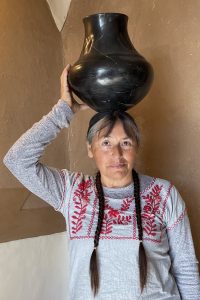
Roxanne Swentzell was a young mother on a small piece of land at Santa Clara Pueblo when she was introduced to permaculture design principles––which dovetailed with her indigenous patterns of thinking and land use. She turned her yard from hard, sun-scorched earth into an agroforest that provides food, wood, fiber and habitat. She founded the Flowering Tree Permaculture Institute, which focuses on teaching principles and practices of desert gardening, composting, seed saving, animal husbandry, beekeeping, building, and maintaining cultural knowledge–based on principles of integrity, love, reciprocity, communication, work, and consideration.
This episode is from the Down to Earth archive and was first posted on August 18, 2023.
This episode is part of the Southwestern Tribal Agroforestry Outreach Project, focused on highlighting Indigenous-led agroforestry projects in the Southwest with the goal of supporting current and future Indigenous-led agroforestry efforts, and the general public. Stay tuned for the release of other project materials including videos, info sheets, a synthesis and webinars! Podcast episode was made possible by a grant from the U.S. Department of Agriculture (USDA), Forest Service, National Agroforestry Center, under the authority of the Cooperative Forestry Assistance Act of 1978. USDA is an equal opportunity provider, employer, and lender.
TIMELINE
1’57 how she started building her house and garden
4’07 the idea of a permaculture food forest
5’26 pattern understanding concept in permaculture, which resonated with her pueblo background
7’07 placing a rock in the yard to create a microclimate
9’36 planted a tree on the northeast side of the rock, and the rock acted as a mother for the tree
11’03 added black locust tree as a nitrogen fixer, good wood, and animal feed
11’27 also brought in Siberian pea shrub
12’13 thinking about invasive/non-native species
12’51 using plants that are adapted to this climate, but also hardy speces from other places that produce food
13’25 seeing whether species act like colonizers or if they get along with the other plants already there
14’23 cheat grass acts like an invasive colonizer plant
16’08 how to listen to the land and hear what it’s telling you
17’24 thinking of her relationship to the land as a love story
21’34.9912 within six years they had a fruitful garden oasis on the land, and the 1/8 acre supported a family of four
22’40 the succession of plants over three decades
23’58 growing bamboo in the desert–it took 20 years to take off and flourish
26’32 the intersection between permaculture design and indigenous traditions she grew up with–balance and regeneration
28’52 how the Flowering Tree Permaculture Institute began
30’48 all kinds of animals and birds on the land
32’06 her children’s reaction to this process
33’18 self-sufficiency a goal but not fully realized
34’55 other Flowering Tree Permaculture projects
36’47 cultural survival–foods crafts language building language practices
39’16 seed saving
41’11 developing a sense of place over a long time, a sense of belonging
45’21 the earth is screaming to be heard
46’56 the difference between jumping outside yourself and going within yourself
48’27 thinking about food even in cities and small places
50’06 the more things we do for ourselves the more we’re taking power back from corporations
51’51 not knowing the stories behind your food when you buy it in a supermarket
52’36 connecting permaculture and her art
This episode is part of the Southwestern Tribal Agroforestry Outreach Project, focused on highlighting Indigenous-led agroforestry projects in the Southwest with the goal of supporting current and future Indigenous-led agroforestry efforts, and the general public. Stay tuned for the release of other project materials including videos, info sheets, a synthesis and webinars! Podcast episode was made possible by a grant from the U.S. Department of Agriculture (USDA), Forest Service, National Agroforestry Center, under the authority of the Cooperative Forestry Assistance Act of 1978. USDA is an equal opportunity provider, employer, and lender.

Subscribe:
Apple Podcasts
Spotify